


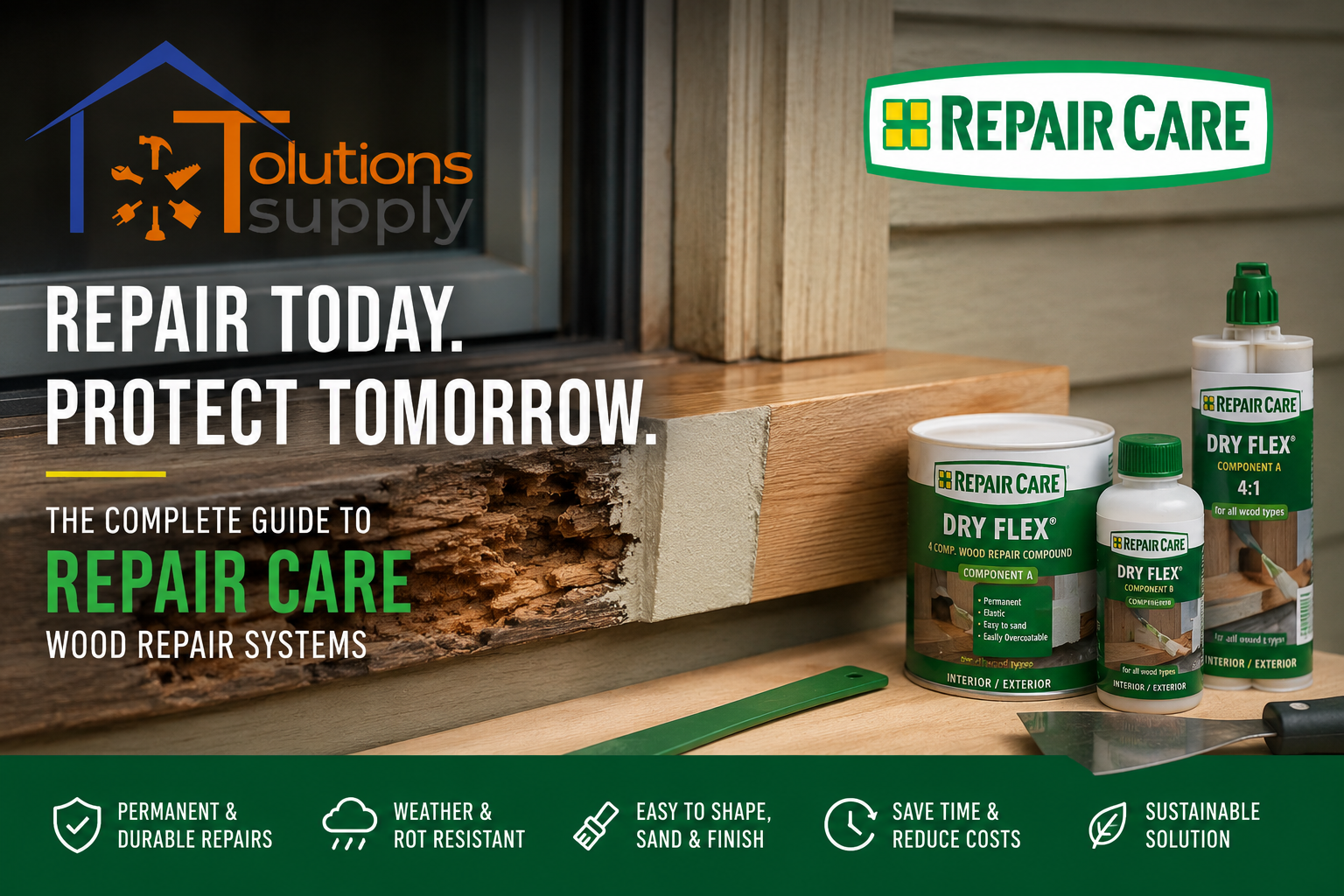
Rotten wood does not always mean the entire window, door, sill, fascia board, column, or trim assembly needs to be replaced.
For contractors, remodelers, painters, restoration specialists, facility managers, and serious homeowners, the better question is whether the remaining wood is sound enough to repair, whether the moisture source can be corrected, and whether the repair system is engineered to move with the wood after it cures. Repair Care is built around that professional restoration logic: remove the unsound material, stabilize the prepared substrate, rebuild the profile with a compatible elastic epoxy compound, then finish the repair so water cannot re-enter the assembly.
Tolutions Supply carries Repair Care products for jobsite-ready wood restoration, including DRY FIX UNI, DRY FLEX 4 2-in-1, DRY FLEX Super Finish 2-in-1, EASY Q tools, wood condition meters, knives, wipes, mixing accessories, and contractor starter packs. For contractors who already buy specialty products like fasteners, wood finishes, decking, siding, cabinets, and building envelope materials, Repair Care fits the same purchasing philosophy: professional products selected for real jobsite performance, not commodity patch materials.
This guide explains when Repair Care is the right choice, how the system works, where it outperforms ordinary fillers, and how to build a more durable repair specification for exterior wood components.
What Is Repair Care?
Repair Care is a professional wood repair system that combines substrate stabilization and elastic two-component epoxy repair compounds. Its core purpose is permanent repair of decayed, damaged, cracked, or missing wood where full replacement is not required or would be inefficient. The system is commonly used on windows, doors, fascias, soffits, stairs, furniture, trim, millwork, and other interior or exterior timber elements.
The important distinction is that Repair Care is not just a tub of filler. DRY FIX UNI is used to condition and stabilize prepared wood before the repair resin is applied. DRY FLEX products then rebuild the missing or damaged section. Repair Care technical documentation describes DRY FLEX 4 2-in-1 as an elastic repair compound for fast wood repairs and splicing that can typically be sanded and painted after about four hours for a 3/8-inch repair at 68°F, with cure time affected by temperature and humidity. Repair Care DRY FLEX 4 2-in-1 technical documentation also notes that the cured material can be worked like wood, including sanding, drilling, sawing, planing, nailing, screwing, painting, or staining when properly cured.
That combination of stabilization, adhesion, shapeability, elasticity, and finish compatibility is why the system is useful for professional repair work where standard spackle, putty, Bondo-style fillers, or brittle patch compounds are poor long-term choices.
Why Wood Rot Repairs Fail
Most failed wood repairs have the same root causes. The installer patches over wet wood, leaves decay behind, ignores the leak or drainage problem, uses a filler that shrinks or becomes brittle, skips primer or stabilizer, or paints the repair before the material is ready. A good repair system cannot overcome bad diagnosis.
Wood is hygroscopic, which means it gains and loses moisture as surrounding conditions change. The USDA Forest Products Laboratory explains wood properties, moisture behavior, decay risk, fastening, and design considerations in the widely referenced Wood Handbook: Wood as an Engineering Material. In practical field terms, this means exterior repairs must be approached as a moisture-management problem first and a filling problem second.
Before choosing Repair Care or any epoxy system, inspect the assembly. Look for failed caulk joints, end-grain exposure, missing drip edges, poor flashing, trapped water behind paint, failed glazing, gutter overflow, soil splashback, and horizontal surfaces that hold water. Unless the water source is corrected, the surrounding wood can keep deteriorating even if the patched area looks perfect on day one.
Best Applications for Repair Care
· Rotted window sills, sash corners, frames, brick mould, and exterior casing where the surrounding wood is still serviceable.
· Exterior doors, jamb bottoms, thresholds, and casing damaged by splashback or failed weatherstripping.
· Fascia, soffit returns, rake trim, porch columns, brackets, and decorative millwork where replacing the entire profile would be costly.
· Historic homes and older buildings where preserving original woodwork is preferable to replacing it with modern profiles.
· Commercial maintenance work where localized repair reduces downtime and avoids unnecessary demolition.
· Pre-paint repairs where the surface must be shaped, sanded, primed, and finished to blend into existing trim.
When Replacement Is Better Than Repair
Repair Care is powerful, but it is not magic. Replacement is usually the better recommendation when decay extends through a structural member, when the wood cannot be dried, when the component is actively moving or failing, when the moisture source cannot be corrected, or when the remaining material is too weak to provide a sound repair boundary. For structural questions, contractors should defer to project specifications, local code requirements, and qualified design professionals.
The American Wood Council and the International Code Council are useful authority resources for wood construction, code context, and design responsibilities. Epoxy repair products are excellent for restoration and non-structural rebuilding, but they should not be used as an undocumented substitute for engineered structural repair.
For projects where the repair scope turns into replacement, upgraded wood, cladding, beams, or factory finishing may make more sense. Contractors working on premium exterior packages can review Everwood Processing Services, explore compatible Materials, or consider specialty options such as Shou Sugi Ban and Custom Laminated Beams when the project calls for upgraded architectural wood elements rather than localized repair.
Repair Care vs. Wood Filler vs. Replacement
|
Option |
Best Use |
Advantages |
Limitations |
|
Repair Care epoxy system |
Rotted, cracked, missing, or damaged wood where the surrounding substrate is sound |
Elastic repair; compatible primer/stabilizer; shapeable; sandable; paintable; reduces demolition |
Requires moisture diagnosis, proper prep, mixing, cure time, and finishing |
|
Conventional wood filler or putty |
Small nail holes, shallow cosmetic defects, dry interior repairs |
Low cost; easy to sand; fast for minor cosmetic work |
Poor choice for active exterior rot, deep voids, wet wood, or moving joints |
|
Dutchman/splice repair |
Localized damage where a new wood section can be let into the old part |
Uses real wood; good for larger sections; traditional restoration method |
Requires carpentry skill, tight joinery, adhesive/fastening strategy, and finish integration |
|
Full replacement |
Severe decay, structural failure, repeat moisture problems, or unsalvageable components |
Resets the assembly; can improve design, flashing, drainage, and material selection |
Higher cost; more demolition; may lose original profiles or historic material |
Professional Repair Workflow
1. Diagnose the moisture problem first
A durable repair starts with the question, “Why did this wood fail?” On a window sill, it may be failed glazing, unsealed end grain, missing paint, or poor slope. On fascia, it may be a gutter leak or roof-edge detail. On a jamb bottom, it may be capillary water, splashback, or failed threshold sealing. Correcting the moisture path is the difference between a professional repair and a temporary patch.
2. Remove coatings and decayed wood
Open the repair area enough to see the true condition of the substrate. Remove loose paint, failed coatings, punky wood, and material that no longer holds shape. A small visible blister can hide a larger pocket of decay. Do not trap soft, infected material under epoxy and paint.
3. Check the wood condition
Use a wood condition meter or moisture meter before applying repair products. Tolutions Supply carries the EASY Q Wood condition meter CS1 because moisture testing is a practical quality-control step, not a luxury. If the wood is too wet, dry the area, improve ventilation, or delay the repair until conditions are suitable. Wet repairs are one of the most common reasons patch work fails.
4. Apply DRY FIX UNI to prepared wood
DRY FIX UNI is the system primer/stabilizer used before compatible DRY FLEX repair compounds. Its role is to penetrate and prepare the remaining wood, support adhesion, and create a better repair interface. Apply it according to Repair Care instructions and respect open times before installing the repair compound.
5. Mix and apply DRY FLEX correctly
DRY FLEX 4 2-in-1 is supplied in a cartridge and mixed before application. Mix until the material is homogeneous. For deeper voids, build the repair so the material can cure correctly and maintain the profile. Shape slightly proud of the finished surface so it can be sanded flush after curing. For fine surface defects, DRY FLEX Super Finish 2-in-1 is designed for finer finishing work rather than bulk rebuilding.
6. Sand, profile, prime, and paint
Once cured, the repaired area can be shaped, sanded, and finished. The final coating system matters. Prime exposed wood, seal end grain, maintain paint film thickness, and use compatible exterior coatings. A high-quality epoxy repair still depends on a water-shedding paint and sealant system.
Practical Examples
Rotted window sill corner
A common repair begins with a blistered sill corner. Remove the failed paint and probe the wood. If the decay is limited to the outer corner and the sill remains sound, remove the decayed material, dry the area, treat with DRY FIX UNI, rebuild with DRY FLEX 4, sand to the original sill profile, prime, and paint. Also check that the sill has slope, the end grain is sealed, and water is not entering from failed glazing or trim joints.
Door jamb bottom
A jamb bottom often fails from repeated wetting at the threshold. If the framing is sound and the damage is localized, Repair Care can rebuild the jamb profile without removing the entire door unit. The installer should also correct the weatherstrip, threshold seal, flashing, or porch drainage issue that caused the failure.
Historic trim profile
On older homes, decorative profiles can be difficult to match. Repair Care allows a contractor to preserve the original profile by rebuilding missing sections in place. This can be more efficient than custom milling a small replacement section, especially when the profile is only damaged in one or two locations.
What Contractors Should Order
For a contractor trying Repair Care for the first time, the Contractor Starter Pack is usually the most efficient entry point because it combines DRY FLEX, DRY FIX, and EASY Q accessories in one system. For repeat users, order the specific resins, stabilizers, knives, wipes, mixing plates, dispensing tools, and wood condition meters needed for the crew. The goal is to standardize the workflow so every technician repairs wood the same way rather than improvising with whatever filler is in the truck.
Contractors can shop Repair Care products through Tolutions Supply and source related jobsite materials such as premium wood finishes, specialty fasteners, building materials, and contractor-focused supplies from the same purchasing channel.
Specification Notes for Pros
· Do not specify epoxy repair until the source of moisture has been identified and corrected.
· Require removal of all decayed and unsound wood before stabilization.
· Require substrate condition or moisture checks before application.
· Require compatible primer/stabilizer before the repair compound where the manufacturer calls for it.
· Require curing before sanding, machining, priming, or painting.
· Do not represent cosmetic epoxy repair as a code-approved structural repair unless an engineer or applicable code path supports that use.
· Include coating maintenance expectations in the owner handoff, especially for exterior windows, doors, trim, and millwork.
For larger exterior wood packages, samples and finish expectations can be coordinated early. Contractors and architects can Order a Sample or use Contact Us to discuss custom processed wood when repair is no longer the best path and replacement material needs to match a higher design standard.
FAQs About Repair Care Wood Repair
Is Repair Care better than regular wood filler?
For exterior rot, deep damage, cracks, and profile rebuilding, Repair Care is usually a stronger professional option because it combines substrate preparation with elastic epoxy repair compounds. Standard wood filler is better reserved for small cosmetic defects in dry, low-risk areas.
Can Repair Care be used outside?
Yes. Repair Care products are commonly used for exterior windows, doors, fascias, soffits, and trim when the wood is properly prepared and the repair is finished with a suitable coating system.
Does Repair Care stop wood from rotting again?
It repairs the damaged area, but it does not eliminate the moisture source by itself. The contractor still needs to fix leaks, failed paint, poor flashing, bad drainage, or other water-entry conditions.
Can Repair Care be painted?
Yes. After the product has cured according to manufacturer instructions, it can be sanded and painted. Proper priming and exterior paint maintenance are critical for long-term performance.
Can Repair Care be drilled or screwed after curing?
Repair Care documentation states that cured DRY FLEX can be treated like wood, including sanding, drilling, sawing, planing, nailing, screwing, painting, or staining, when fully cured and used as directed.
When should I replace the wood instead of repairing it?
Replace the component when decay is extensive, the wood cannot be dried, the member is structural and compromised, the repair boundary is not sound, or the water problem cannot be corrected.
What is the difference between DRY FIX UNI and DRY FLEX?
DRY FIX UNI is the stabilizer/primer applied to prepared wood. DRY FLEX is the epoxy repair compound used to rebuild, fill, and shape the damaged area.
Where can contractors buy Repair Care?
Contractors can buy Repair Care through Tolutions Supply, including individual products and contractor starter packs for a complete professional repair workflow.
Bottom Line: Repair First When the Wood Is Worth Saving
Repair Care gives contractors a professional alternative to unnecessary replacement. Used correctly, it can restore damaged exterior and interior wood, preserve original profiles, reduce demolition, and deliver a clean paint-ready repair. The keys are disciplined inspection, moisture control, complete decay removal, correct use of DRY FIX and DRY FLEX products, and a finishing system that keeps water out after the repair is complete.
For contractors, remodelers, painters, and restoration teams, the value is not just the product in the cartridge. It is a repeatable repair system that helps crews produce better outcomes and gives customers a smarter option when the wood is damaged but not beyond saving.


