


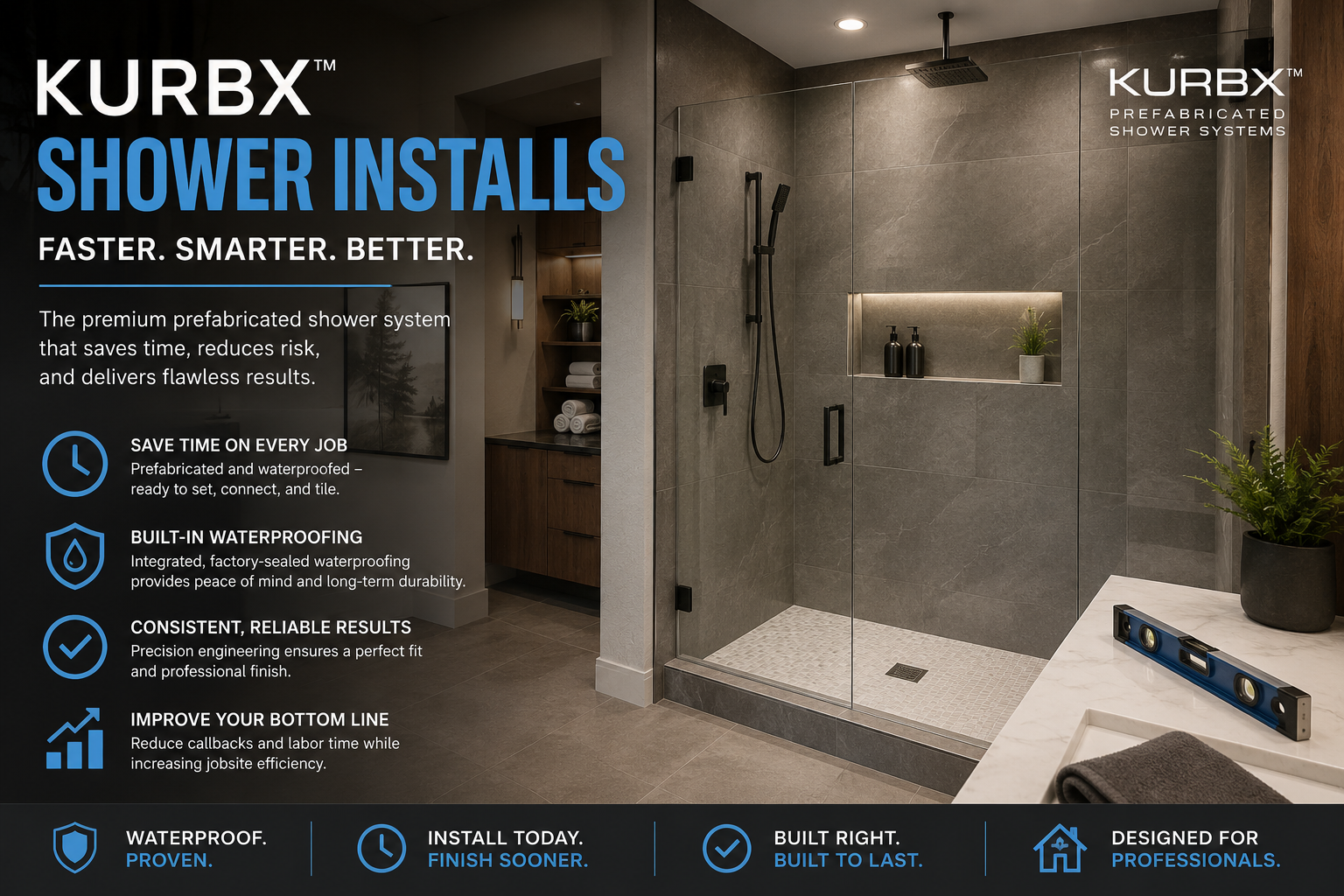
Curbless showers are no longer a niche upgrade. They have become a standard request in higher-end remodels, aging-in-place projects, multifamily renovations, hospitality bathrooms, and modern residential construction. The problem is that many traditional curbless installations are slow, labor-heavy, and unforgiving. Framing has to be planned correctly. Slope has to be right. Waterproofing has to be clean. Drain location has to make sense. Tile selection has to match the pitch. If one trade misses a detail, the contractor owns the callback.
KurbX was designed to solve that problem for real installers. Instead of building the entire shower base from scratch with a traditional mud-set process, KurbX uses a structural, pre-sloped shower pan system that can replace the subfloor to create a curbless shower. For contractors, that changes the project from a highly variable field-built slope into a more repeatable system. It is still a professional installation. It still requires proper framing, waterproofing, tile work, and plumbing coordination. But it gives the contractor a better starting point.
Tolutions Supply supports contractors who need reliable bathroom installation products, shower systems, and jobsite-ready materials. If your crew is bidding bathroom remodels, senior living upgrades, multifamily unit turns, or custom tile showers, KurbX deserves a close look.
Why Curbless Showers Are in Demand
Customers like curbless showers because they look clean, open, and modern. Removing the curb can make a bathroom feel larger, especially in smaller spaces. Curbless layouts also improve access for aging-in-place clients, wheelchair users, walkers, and anyone who wants fewer trip points in the bathroom. For contractors, that demand creates opportunity, but it also raises expectations.
A curbless shower must do several things correctly at the same time. It must drain consistently. It must transition cleanly to the bathroom floor. It must be waterproofed beyond the pan area. It must support the finished tile or solid surface. It must coordinate with the plumbing rough-in and joist layout. It must also meet the design expectation that made the customer want curbless in the first place.
Traditional mud work can absolutely deliver a good shower in the hands of the right installer. The challenge is consistency, time, and trade coordination. KurbX gives contractors a pre-engineered way to reduce some of that variability.
What KurbX Is
KurbX makes structural shower pans for curbless and curbed applications. The manufacturer describes the pans as combining the strength and durability of a traditional mud-set with the versatility of foam. The system is proprietary and patented, pre-sloped, and made from glass reinforced plastic produced by compression mold. KurbX pans are designed to replace the subfloor in curbless installations and create a tile-ready or solid-surface-ready shower base after proper waterproofing.
The physical profile is a major contractor benefit. KurbX’s shower pan spec sheet lists a thin 15/16-inch perimeter profile, self-support on 16-inch on-center floor joists, four precision-engineered slopes, a centered and tub-replacement drain location, a textured surface, ribbed underside, and pre-drilled screw holes. Those details matter because they help crews plan the install and understand where the system fits into framing and remodeling workflows.
KurbX also promotes several jobsite benefits: the pans can span 16-inch on-center floor joists, are pitch-perfect for consistent water drainage, can be cut to shape or size, and are ready for tile the same day when installed and waterproofed correctly. For many contractors, the biggest value is predictability.
Main Benefits of KurbX for Contractors
The first benefit is speed. A traditional mud-set shower base requires skilled labor, mixing, forming, sloping, curing, and schedule coordination. KurbX reduces that process by providing a structural pre-sloped pan that can be installed into the floor assembly. Less jobsite variability means crews can move faster and schedule other trades with more confidence.
The second benefit is consistent slope. Drainage complaints are one of the fastest ways for a shower job to become expensive. KurbX pans are engineered with precision gradients, helping contractors create a consistent drainage plane. The installer still needs to plan tile layout, waterproofing, and drain details correctly, but the slope is not being invented from scratch on site.
The third benefit is structural installation flexibility. KurbX pans are designed to span 16-inch on-center joists and can be installed during the rough framing phase. That is important for new construction, larger remodels, and production-style work where sequencing matters. A system that can be part of the framing conversation is easier to plan than a shower base that only appears after everything else is closed up.
The fourth benefit is layout flexibility. KurbX says pans can be cut to shape or size, and the system can be used in multiple installation types, including direct-to-joist, solid wood substrate, concrete slab, and upper-level concrete applications. That flexibility is useful for remodelers dealing with existing bathrooms, tub-to-shower conversions, second-floor installs, and unusual dimensions.
The fifth benefit is marketability. Contractors can sell curbless showers as a design upgrade, accessibility upgrade, and practical cleaning upgrade. KurbX helps support that sale with a system that is faster and more repeatable than building every base from scratch.
How a KurbX Curbless Install Works
KurbX describes the curbless installation process in four core steps. First, remove the subfloor and install support blocking. Second, set the pan and secure the drain waste. Third, waterproof the pan and surrounding area. Fourth, finish the installation with the chosen tile. That sounds simple, but each step deserves careful jobsite execution.
The first step is planning. Before demo, confirm the shower footprint, drain location, joist direction, floor height, finished tile thickness, adjacent floor elevation, plumbing access, and waterproofing strategy. Curbless showers require the bathroom floor and shower entry to work together. Do not treat the pan as an isolated product.
Once demo begins, the crew removes the subfloor in the shower footprint and installs the required support blocking. This is where the structural nature of the pan matters. Blocking must be installed correctly so the pan is supported as intended. The rough opening, joist layout, and drain position should be verified before fastening.
Next, the pan is set and the drain waste is secured. KurbX highlights a simple three-part screwless drain assembly that is self-contained and centered in the pan. Contractors should still coordinate with plumbing code requirements, trap location, access, and drain line pitch. A product that simplifies the pan does not eliminate the need for proper plumbing.
After the pan is installed, waterproofing becomes the critical quality-control step. Waterproof the pan and surrounding area according to the system instructions. In curbless work, the waterproofing strategy must extend beyond the immediate shower base because water can travel past the wet area. Corners, seams, penetrations, wall transitions, and the bathroom floor interface all need attention.
Finally, install tile or the selected solid surface floor covering. KurbX notes that 2-inch by 2-inch or smaller tile is typical on shower pans, while larger bases can handle larger tile depending on installer expertise. Large-format tile may require an envelope cut detail to follow pitch lines correctly.
Curbless vs. Curbed KurbX Installations
Although curbless is the headline, KurbX can also be used for curbed shower installations. That gives contractors flexibility when the job does not require a barrier-free entry or when field conditions make curbless less practical. A curbed shower can still benefit from a pre-sloped structural pan, a cleaner drain assembly, and faster installation compared with a fully traditional build.
For remodelers, this is useful because not every bathroom is a good candidate for a fully curbless layout without additional framing, floor-height, or plumbing work. Being able to offer both curbless and curbed solutions helps contractors guide the customer toward the right system rather than forcing one design into every project.
Planning Drainage and GPM Before Installation
Drainage is not only about the drain. It is about the entire shower system. KurbX states that its drain itself can handle up to 5.5 gallons per minute, but it also warns contractors to consider the steady-flow GPM desired in the shower. Oversized supply lines, removed flow restrictors, multiple shower heads, pan size, and continuous water flow can all change what the system needs to handle.
This is a key contractor talking point. A standard shower head is one thing. A luxury shower with multiple heads, body sprays, and a hand shower running at the same time is another. Before selling a curbless shower, confirm the fixture package and expected water volume. If the project needs higher capacity, design adjustments may be required, such as using larger layouts, multiple pans, mini pitch fillers, or other details recommended by the manufacturer.
Tile Selection and Layout Considerations
Tile choice can make or break the finished shower. Smaller tile naturally follows slope changes more easily, which is why mosaic tile is common in shower pans. KurbX typically recommends 2-inch by 2-inch or smaller tile, while noting that larger bases may handle larger tile depending on the installer’s skill. Larger tile can still work when the installer cuts the pitch lines for an envelope detail, but that requires planning and craftsmanship.
Contractors should discuss tile limitations before the customer buys material. A designer may select a large-format tile for the bathroom floor without realizing the shower pan requires slope changes. The right time to catch that issue is during planning, not after tile is delivered.
Thin-set selection matters too. KurbX’s installation FAQ says to use modified thin-set for setting tile. Crews should also follow the waterproofing manufacturer’s requirements and tile industry best practices.
Waterproofing Is Not Optional
A faster pan does not mean a shortcut shower. Waterproofing remains essential. Curbless showers are especially sensitive because there is no curb to act as a visual or physical boundary. The waterproofing plan should include the pan, wall-to-floor transitions, seams, penetrations, drain flange area, and the surrounding bathroom floor as needed.
KurbX references SeeLIT joint tape and waterproofing in its installation guidance, including for screw heads when the pan is fastened outside the recessed drain flange area. The contractor should follow the current KurbX and waterproofing instructions for the exact system being installed.
For professional work, document the waterproofing stage. Photos before tile can be valuable for customers, inspectors, general contractors, and your own records.
Best Applications for KurbX
KurbX is a strong fit for bathroom remodels where the customer wants a modern curbless look, tub-to-shower conversions, aging-in-place projects, multifamily renovations, hospitality bathrooms, commercial wet rooms, and new construction where consistent installation speed matters. It is also useful for contractors who want to train crews on a repeatable system instead of relying on one mud-bed specialist for every custom shower.
KurbX can also help on projects with tight schedules. If a system reduces cure-time dependency and creates a more predictable installation sequence, the contractor can better coordinate plumbing, tile, waterproofing, inspections, and final finishes.
Common KurbX Installation Mistakes to Avoid
The first mistake is poor planning. Curbless showers must be designed as part of the room, not just the shower footprint. Floor height, tile thickness, drain capacity, door or glass layout, and waterproofing all interact.
The second mistake is ignoring the fixture package. Multiple shower heads can overwhelm a design if GPM is not considered. The third mistake is choosing tile that does not work with the slope. The fourth mistake is treating waterproofing as a quick coating step instead of a system. The fifth mistake is failing to coordinate rough framing and blocking before the pan goes in.
Contractors should also avoid assuming every bathroom is automatically curbless-ready. Sometimes a curbed KurbX installation, a larger pan, added pitch fillers, or additional framing work is the better recommendation.
Contractor Takeaway
KurbX gives contractors a faster, more repeatable way to install curbless and curbed shower systems. The value is not just speed. It is consistent pitch, structural support, flexible layouts, cleaner sequencing, and a more professional sales story for modern bathrooms and accessibility-focused projects.
The best results still come from good planning. Confirm the layout, joists, drain, tile, waterproofing, fixture GPM, and finished floor elevations before installation. Use KurbX as a system, not a shortcut. When installed correctly, it can help contractors deliver high-value shower projects with fewer variables and a cleaner path from demo to tile.
For contractor pricing, product availability, and project support, visit Tolutions Supply’s KurbX shower system products or contact the Tolutions Supply team.
Internal Links to Add:
· KurbX shower systems from Tolutions Supply: https://tolutionssupply.com/search?q=kurbx
· Bathroom and shower installation products from Tolutions Supply: https://tolutionssupply.com/collections/bathroom
Outbound Authority Links to Add:
· KurbX Curbless Shower Systems: https://kurbx.com/
· KurbX Curbless Installation Guidance: https://kurbx.com/curbless-installation
FAQs About KurbX Shower Installs
1. Is KurbX only for curbless showers?
No. KurbX is known for curbless structural shower systems, but it can also be used for curbed shower installations when the project calls for a curb or when field conditions make curbless less practical.
2. Can KurbX pans span floor joists?
Yes. KurbX states that its structural shower pans can span 16-inch on-center floor joists when installed according to the system requirements. Proper blocking and support are still critical.
3. What type of tile works best on a KurbX shower pan?
KurbX typically recommends 2-inch by 2-inch or smaller tile on shower pans. Larger tile may be possible on larger bases or with envelope cuts, depending on the installer’s expertise and the layout.
4. How much water can the KurbX drain handle?
KurbX states that the drain itself can handle up to 5.5 gallons per minute. Contractors still need to evaluate the entire shower design, including multiple heads, supply lines, flow restrictors, and pan size.
5. Does KurbX eliminate waterproofing work?
No. KurbX can simplify the shower base installation, but waterproofing is still required. The pan, seams, screw heads where applicable, drain area, wall transitions, and surrounding bathroom floor must be waterproofed according to the system instructions.


